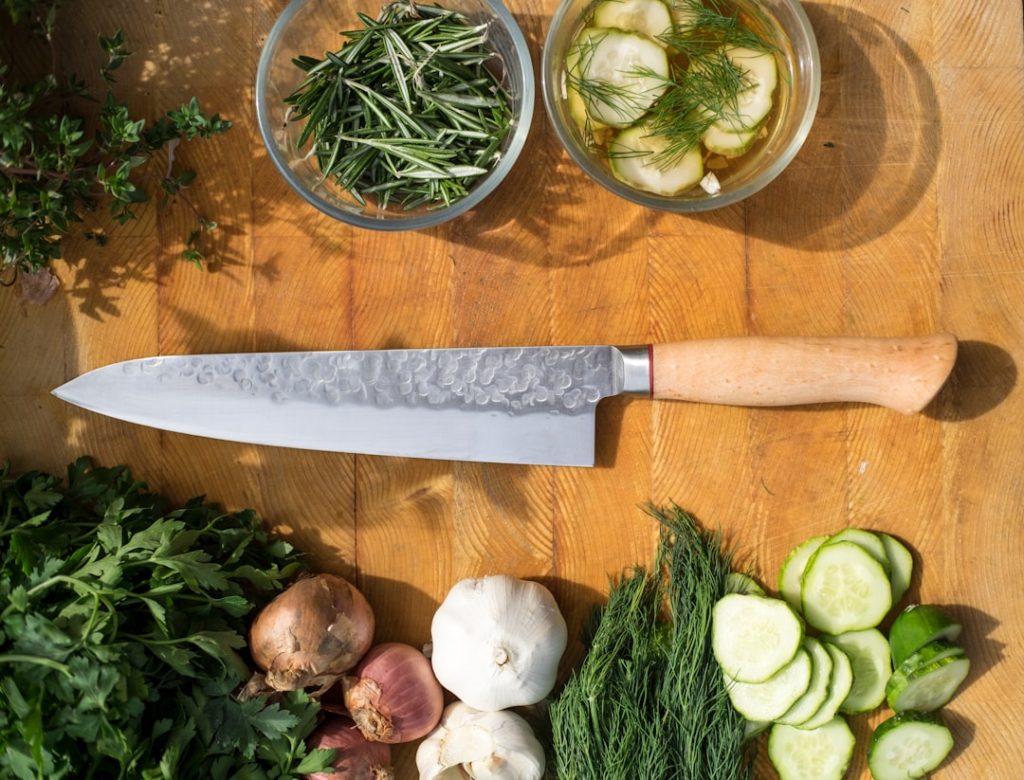
The main difference between a chef knife and a santoku knife lies in their shape, weight, and the type of cutting motion they facilitate. A chef knife is a versatile workhorse with a curved blade designed for a rocking motion, making it ideal for large-scale chopping, slicing meat, and heavy-duty prep. A santoku knife has a straighter blade edge and often features “granton” grooves (those little indentations on the side) to prevent food from sticking. It is generally lighter and designed for precision slicing, dicing, and mincing. If you want a single knife that does everything, go for the chef knife; if you want a specialized tool for quick, precise vegetable work, the santoku is your best friend. I will help you figure out exactly which one belongs in your hand right now.
Why This Question Matters in the Kitchen
I have seen so many home cooks stand in the middle of a grocery store or browse online, paralyzed by choice because they feel like they need every single gadget under the sun. Choosing the wrong knife isn’t just about being “unprofessional.” It is about efficiency, safety, and the actual texture of your food.
If you try to use a thin, delicate santoku to hack through a thick butternut squash or a heavy piece of beef, you risk chipping the edge or feeling extreme fatigue in your wrist. Conversely, if you try to use a heavy, bulky chef knife for extremely fine, delicate herb mincing, you might find yourself frustratingly smashing the leaves into a paste rather than clean-cutting them. Getting this right saves you money by preventing wasted food and saves your hands from unnecessary strain.

The Full Explanation: Understanding the DNA of Your Knives
To truly master your knife skills, you have to understand how the geometry of the blade dictates the way you move your hand.
The Versatile Chef Knife
The chef knife is the undisputed king of the Western kitchen. Most traditional chef knives have a pronounced curve from the heel to the tip. This curvature is the “engine” of the knife. Because the blade is bowed, you can keep the tip of the knife in contact with your cutting board and “rock” the handle up and down. This rocking motion is incredibly fast and efficient for finely mincing garlic, shallots, or parsley.
Beyond just rocking, the weight of a chef knife provides momentum. When you are slicing through a thick protein, the weight of the steel does a lot of the work for you. This makes it a “heavy-duty” tool. It is the knife you reach for when you are prepping a whole chicken or a massive pile of potatoes.
The Precision Santoku Knife
The word “santoku” translates roughly to “three virtues” in Japanese, referring to its proficiency in three areas: slicing, dicing, and mincing. Unlike the chef knife, the santoku typically features a flatter blade profile. This means you cannot easily use a rocking motion. Instead, the santoku is designed for a “push-cut” or “chop” motion. You lift the knife almost entirely off the board and move it forward and down in a slicing motion.
You will often notice small divots along the side of a santoku blade. These are called granton edges. From a food science perspective, these grooves create tiny pockets of air between the blade and the food. This reduces the surface tension and suction that occurs when you are cutting wet or starchy vegetables like cucumbers or potatoes, preventing them from sliding around and making a mess on your board.
Comparison at a Glance
To make it even clearer, let’s look at how they stack up side-by-side:
| Feature | Chef Knife | Santoku Knife |
|---|---|---|
| Primary Motion | Rocking | Push-cutting / Chopping |
| Blade Shape | Curved (Belly) | Straighter (Flatter) |
| Weight | Heavier / Robust | Lighter / Nimble |
| Best For | Meat, large veggies, heavy prep | Vegetables, herbs, delicate slicing |
| Origin | Western/French tradition | Japanese tradition |
Factors That Change the Answer
While I have given you the general rules, the “right” knife often depends on what is currently sitting on your cutting board.
Ingredient Texture and Density
If you are working with dense, fibrous vegetables like carrots, beets, or sweet potatoes, a chef knife provides the leverage needed to drive through the skin without the blade glancing off. If you are working with delicate greens or thin slices of radish, the lighter, sharper profile of a santoku allows for much higher precision without bruising the cell walls of the plant.
Your Hand Size and Grip Style
This is something people rarely consider. If you have larger hands, a smaller santoku might feel like a toy, giving you very little control. You need the heft of a chef knife to feel balanced. If you have smaller hands or prefer a light touch, a heavy professional-grade chef knife might feel cumbersome, making the santoku a much more natural extension of your hand.
The Type of Task
If you are prepping for a big Sunday roast—meaning you have a lot of meat to trim and a lot of heavy vegetables to chop—the chef knife is your primary tool. If you are prepping a delicate summer salad with very thin slices of cucumber, bell pepper, and radish, the santoku will allow you to achieve that “restaurant-style” thinness much more easily.

Step by Step: How to Use Each Knife Correctly
Knowing which knife to grab is only half the battle; you have to use the motion the knife was designed for.
How to use a Chef Knife (The Rocking Motion)
- Place your non-dominant hand on the handle of the cutting board to stabilize it.
- Form a “claw” with your knife hand, tucking your fingertips inward to protect them.
- Rest the heel of the blade on the cutting board.
- Press down on the handle and lift the tip of the knife slightly off the board.
- Push the handle down in a circular, rocking arc, keeping the heel in contact with the board throughout the motion.
How to use a Santoku Knife (The Push-Cut)
- Stabilize your cutting board with your non-dominant hand.
- Form a “claw” with your knife hand to guide the food.
- Lift the entire knife off the board.
- Move the blade in a forward and downward motion, like you are pushing a plow through soil.
- Bring the knife back to the starting position in the air to repeat the slice.
What Happens If You Get This Wrong
The consequences of using the wrong knife are usually minor, but they can escalate quickly. If you try to use a santoku for heavy-duty meat butchery, you might find the blade “flexing” or twisting, which can lead to uneven cuts or, worse, a slip that results in a deep cut to your hand.
More commonly, the issue is one of food quality. Using a heavy chef knife for very fine herb mincing often results in “mashing” the herbs. You end up with a green paste on your board rather than beautiful, individual flecks of herbs. This not only looks unappealing but also releases the essential oils of the herbs too early, causing them to lose their vibrant flavor and aroma before they even hit the pan.
If you ever find that your knives are losing their edge and making these tasks difficult, remember that a dull knife is actually more dangerous than a sharp one because it requires more force and is prone to slipping. For general kitchen maintenance, knowing how to clean food processor blades safely is a great skill to have, as it teaches you the respect required for all sharp edges.
Frequently Asked Questions
Can I use a chef knife for everything?
Yes, a chef knife is the most versatile tool in the kitchen. You can technically perform almost every task with it, but you will sacrifice the precision and speed that a specialized tool like a santoku provides.
Is a Santoku knife better for slicing meat?
Not necessarily. While a santoku can slice cooked meat very well due to its sharpness, it lacks the weight and curved belly required to efficiently slice through raw, thick cuts of meat or heavy bones/sinew.
Do I need both in my kitchen?
If you are serious about cooking, having both is wonderful, but not mandatory. If you can only afford one, buy a high-quality chef knife. It is the foundation of every kitchen.
Why does my Santoku feel duller than my chef knife?
Santoku knives are often ground to a much sharper, thinner angle to facilitate precision. Because the edge is finer, it may feel “sharper” initially, but it might require more frequent honing to maintain that edge compared to the more robust edge of a chef knife.
Can I use a chef knife to mince garlic?
Absolutely. Many professional chefs use a rocking motion with a chef knife to mince garlic in seconds. Just ensure your knife is sharp so you are slicing the garlic rather than crushing it into a mush.
To truly level up your cooking, make sure you are also using the right tools for your sauces. If you’re struggling with textures, check out our guide on Food Processor vs Blender for Making Sauces to ensure you’re choosing the right appliance for the job.
Stop worrying about having a massive knife block filled with twenty different blades. Pick up one excellent chef knife and one excellent santoku, master their specific movements, and you will be ahead of 90% of home cooks. Now, get back into that kitchen and start practicing those rocking motions!