Ever wonder why your morning brew takes ages or why the lights flicker when you hit start? Most home machines use a coffee maker wattage between 900 and 1200 watts to heat water fast. In my years of testing brewers, I found that high power means better heat, but it can also trip your kitchen breaker. Check out my guide below to find the perfect power level for your daily caffeine fix!
Energy-Saving Tips for Your Coffee Maker
Small habits make a big change. I used to be sloppy with my machine until I saw my winter bill jump. Now I use a few tricks to keep things lean. Adopting simple energy-saving habits can lower your power use without ruining your coffee.
- Brew only what you need: Do not heat water you will not drink.
- Turn it off: Do not let the “on” light stay on all day.
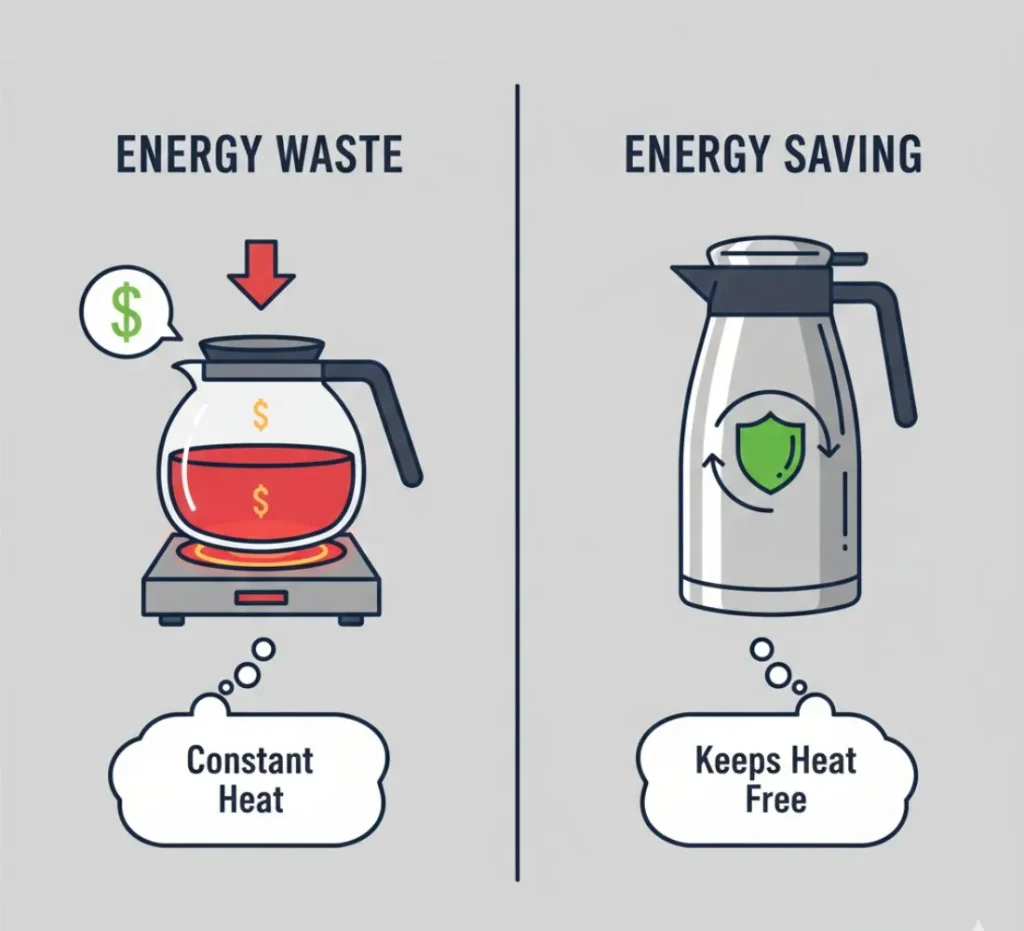
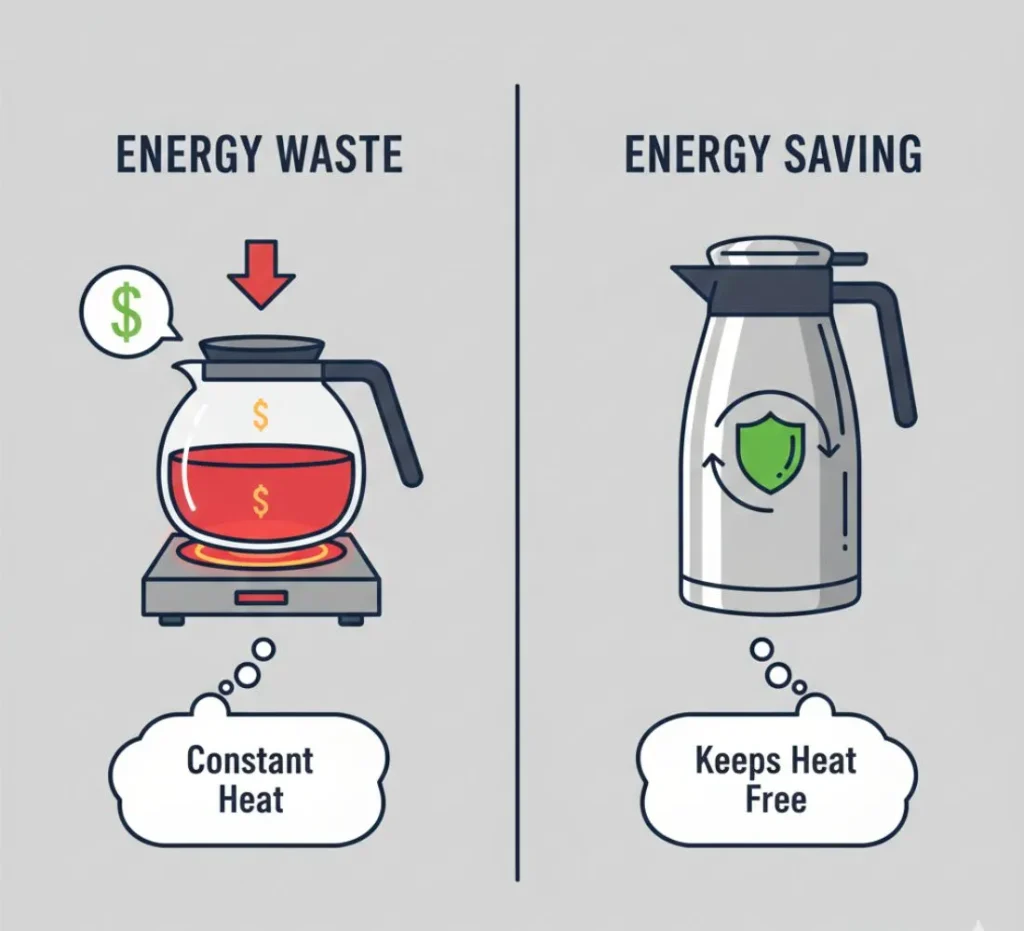
- Use a thermal carafe: Keep coffee hot with physics, not power.
- Keep it clean: Scale on coffee maker parts makes the heater work harder.
What Does Wattage Mean in a Coffee Maker?
Most people see a big number like “1200W” printed on the box and assume it’s just a technical spec for the pros. In reality, that number is the secret to how fast you get your caffeine fix and how much your power company smiles when they send you the bill.
Simple Explanation of Coffee Maker Wattage
When I bought my first machine, I thought “wattage” was just about how loud the motor was. I was wrong. In plain language, wattage is simply the rate at which your coffee maker pulls energy from your wall outlet.
Think of it like a garden hose. A high-wattage machine is a wider hose; it lets more “water” (electricity) flow through at once. In a coffee maker, almost all that power goes toward one goal: heating water.
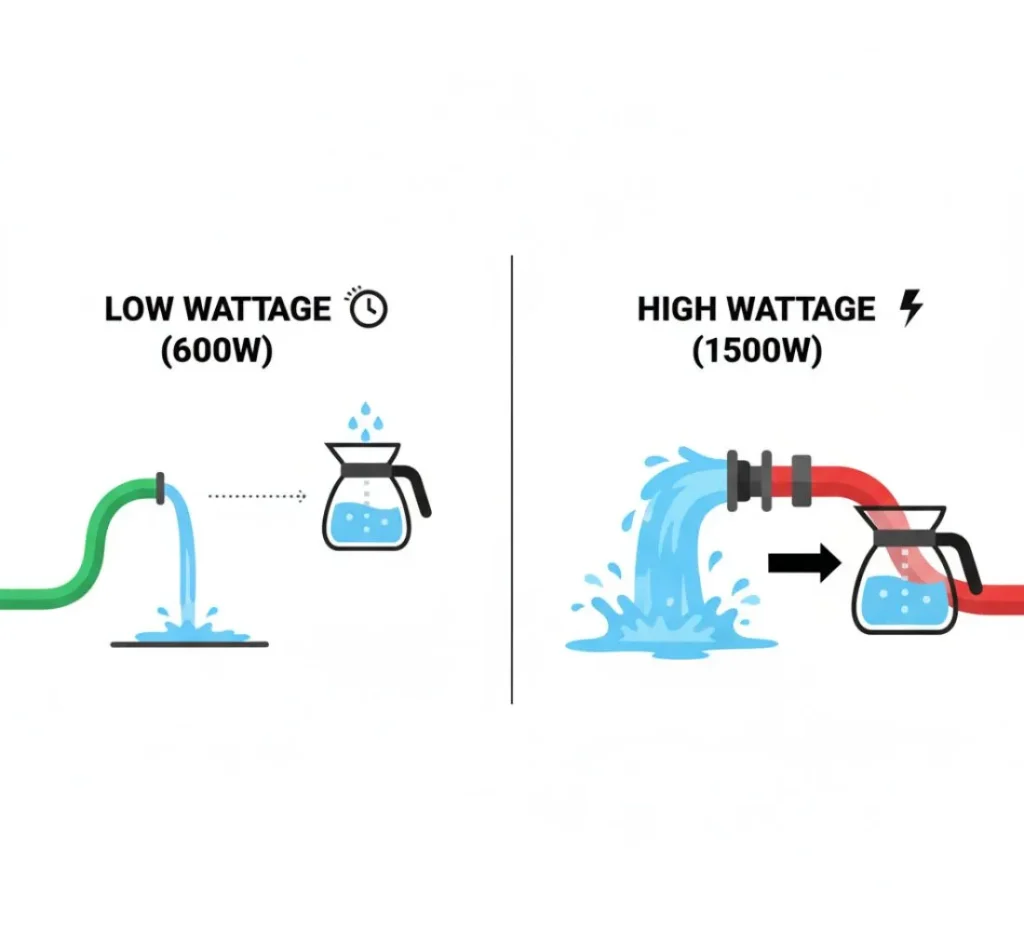
Coffee makers are actually “high-watt” appliances, often using more power than your refrigerator. But don’t panic! Unlike a fridge that runs all day, your coffee maker is a sprinter. It pulls a massive amount of power for five to ten minutes to get that water boiling, and then it’s done. It’s a short, sharp burst of energy rather than a slow, steady drain.
Why Electricity Usage Matters
I used to leave my old machine plugged in all day in my home office. I figured, “It’s just sitting there, right?” Well, those little “on” lights and warming plates add up.
Understanding your usage matters for two reasons:
- The Monthly Surprise: If you brew one pot a day, the cost is pennies. If you run a small office where the machine cycles ten times a morning, you’ll actually see it on your bill.
- Circuit Safety: If you have a high-wattage machine (like 1500W) and you try to run a toaster on the same outlet, you’ll likely trip a breaker. Trust me, nothing ruins a Tuesday morning like a dark kitchen and half-brewed coffee.
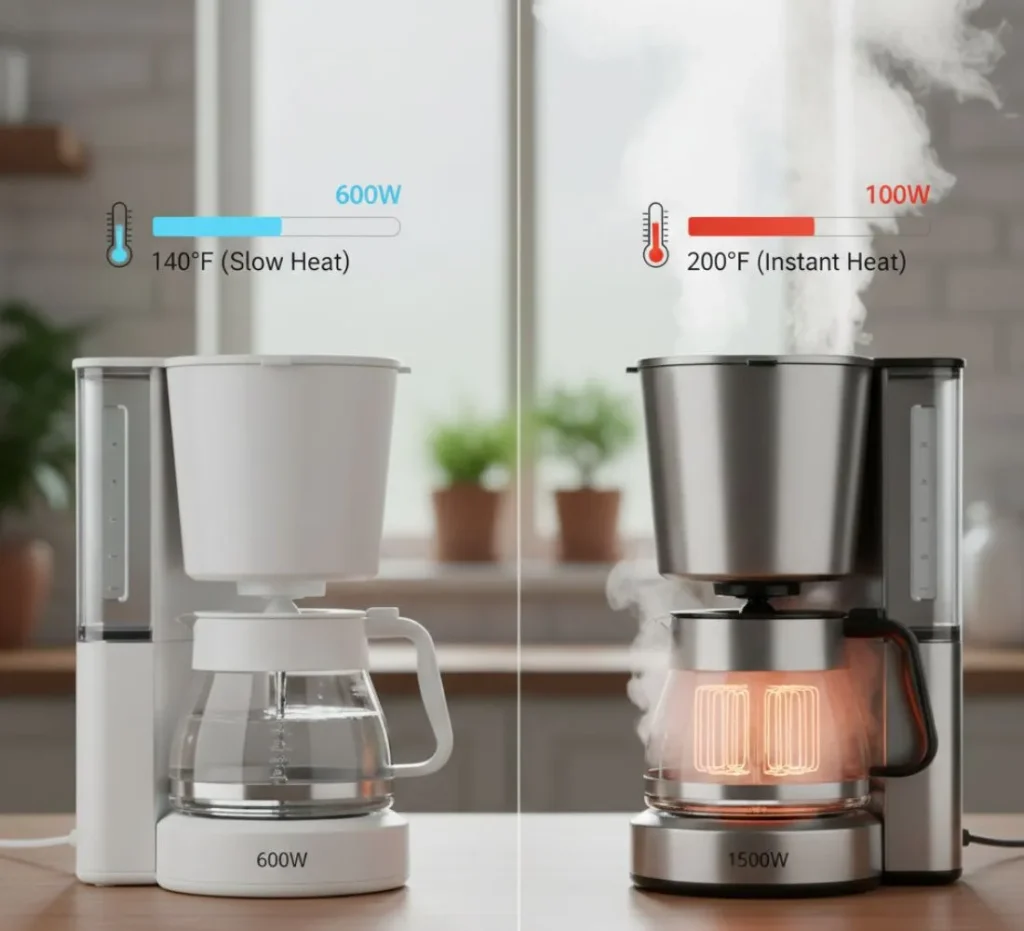
| Feature | Low Wattage (600W) | High Wattage (1500W) |
| Heat Up Time | Slow (Be patient!) | Near Instant |
| Power Intensity | Light | Heavy |
| Best For | Camping/RV | Busy Kitchens |
Who This Guide Is For
I wrote this because I’ve been the person standing in the appliance aisle, squinting at the fine print on the bottom of a box. This guide is specifically for:
- Home Coffee Drinkers: If you just want to know if your morning habit is costing you a fortune.
- Small Office Heroes: The person in charge of keeping the team caffeinated without blowing the office budget.
- Total Beginners: If you’re buying your first machine and want to know why a $30 machine has a different wattage than a $300 one.
I’ve made the mistakes so you don’t have to. Let’s break down how these numbers actually change the way your coffee tastes.
How Coffee Maker Wattage Affects Performance
Higher wattage doesn’t just change power usage it directly affects how your coffee is brewed and how fast your morning starts. From my time testing different machines in my own kitchen, I’ve learned that the numbers on the bottom of the pot tell a story about your coffee’s flavor.
Brewing Speed
We have all been there. It is 7:00 AM on a rainy Monday, you are running late for a meeting, and you’re staring at the coffee pot like it is a slow-motion movie.
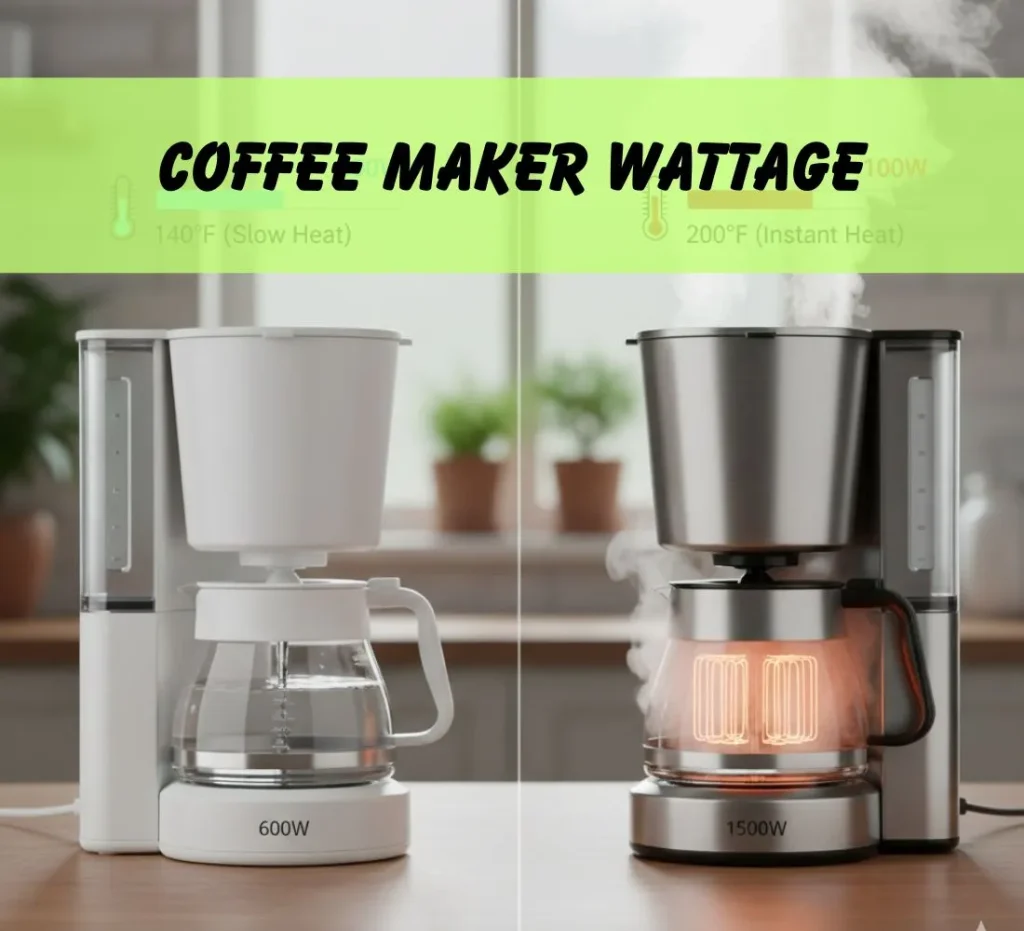
- Low Wattage (The Slow Burn): My old 600W drip machine felt like it took a decade to boil water. It is fine for a lazy Sunday morning when I’m reading the news, but on a workday? It’s painful.
- High Wattage (The Speed Demon): When I switched to a 1400W model, the difference was night and day. It heats up almost instantly.
Higher wattage means the heating element gets hot much faster. If you value your sleep and need a quick cup before you dash out the door, coffee maker wattage is your best friend.
Heat & Temperature Stability
I used to think my coffee tasted bitter because of the beans. Then I learned about “heat stability.” For a perfect cup, water needs to be between 195°F and 205°F.
If your wattage is too low, the water temperature might drop while it’s moving through the machine. This leads to weak, sour coffee. My high-wattage espresso machine stays rock-solid at the right heat. It packs enough punch to keep the water steaming hot even when I’m brewing back-to-back cups for friends. High power equals consistent heat, and consistent heat equals a better-tasting mug.
Electricity Consumption Reality
Here is the truth that surprised me: High wattage does not always mean a high monthly cost. I felt guilty buying a powerful 1500W machine until I did the math. A high-wattage machine works hard, but it finishes the job in three minutes. A low-wattage machine might use less power per second, but it stays “on” for ten minutes to do the same task.
My Realization: Total energy use is about Power x Time.
I would rather have a powerful machine that works fast and turns off. It is much better than a weak one that struggles and stays hot for half an hour. Plus, the flavor is worth the tiny bit of extra peak power.
Common Coffee Maker Wattage Ranges
Not all coffee makers consume the same power. In fact, wattage varies widely depending on design and purpose. When I first started upgrading my kitchen gear, I realized that picking the right range is like picking a car you don’t need a race car just to drive to the grocery store.
Low Wattage Coffee Makers (Approx. 600–900W)
I keep a small 650W machine in my camper for road trips. It is the definition of “slow and steady.”
- Best for: Single users, RVs, or older homes with sensitive fuses.
- The Experience: You will wait longer for your pot to brew. It’s not the machine you want when you have four guests waiting for a cup after dinner.
- The Perk: It has a much lower peak electricity draw. You can usually run this alongside a toaster without worrying about the lights flickering.
Medium Wattage Coffee Makers (Approx. 900–1200W)
This is the “sweet spot” where most of my favorite home machines live. If you walk into a store today, most drip brewers you see will fall right in this bracket.
- The Balance: These offer a great mix of speed and efficiency. They heat water fast enough that the coffee doesn’t taste “stale” from sitting too long, but they aren’t power hogs.
- My Take: For a standard family of four, this is plenty of power. It handles a full 12-cup pot in about 6 to 10 minutes, which fits perfectly into a normal morning routine.
High Wattage & Commercial Models (1200W–1800W+)
Once you cross the 1200W line, you are entering the world of “pro” gear and heavy-duty office machines. I once used a 1600W beast in a small shared workspace, and it was a revelation.
- Built for Speed: These machines are made for volume. They can flash-heat water so you can brew pot after pot without the machine needing a “rest” to warm up again.
- The Drawback: They pull a lot of juice at once. I’ve learned the hard way that you shouldn’t plug these into an extension cord. They need a solid, direct wall outlet.
- Usage Cycle: Even though they are powerful, they finish so fast that they often use less total energy than a weak machine that chugs along for twenty minutes.
Quick Wattage Comparison
| Range | Wattage | Best Use Case | My Personal Rating |
| Low | 600W – 900W | Camping & Solo Living | 3/5 (A bit slow) |
| Medium | 900W – 1200W | Most Households | 5/5 (Just right) |
| High | 1200W – 1800W | Offices & Coffee Nerds | 4/5 (Fast but intense) |
Coffee Maker Types and Their Typical Wattage
Different brewing styles need different power levels, and that’s where many buyers get confused. I remember standing in the kitchen aisle last Saturday, looking at five different types of machines, wondering why an espresso maker needs double the juice of a standard drip pot.
Drip Coffee Makers
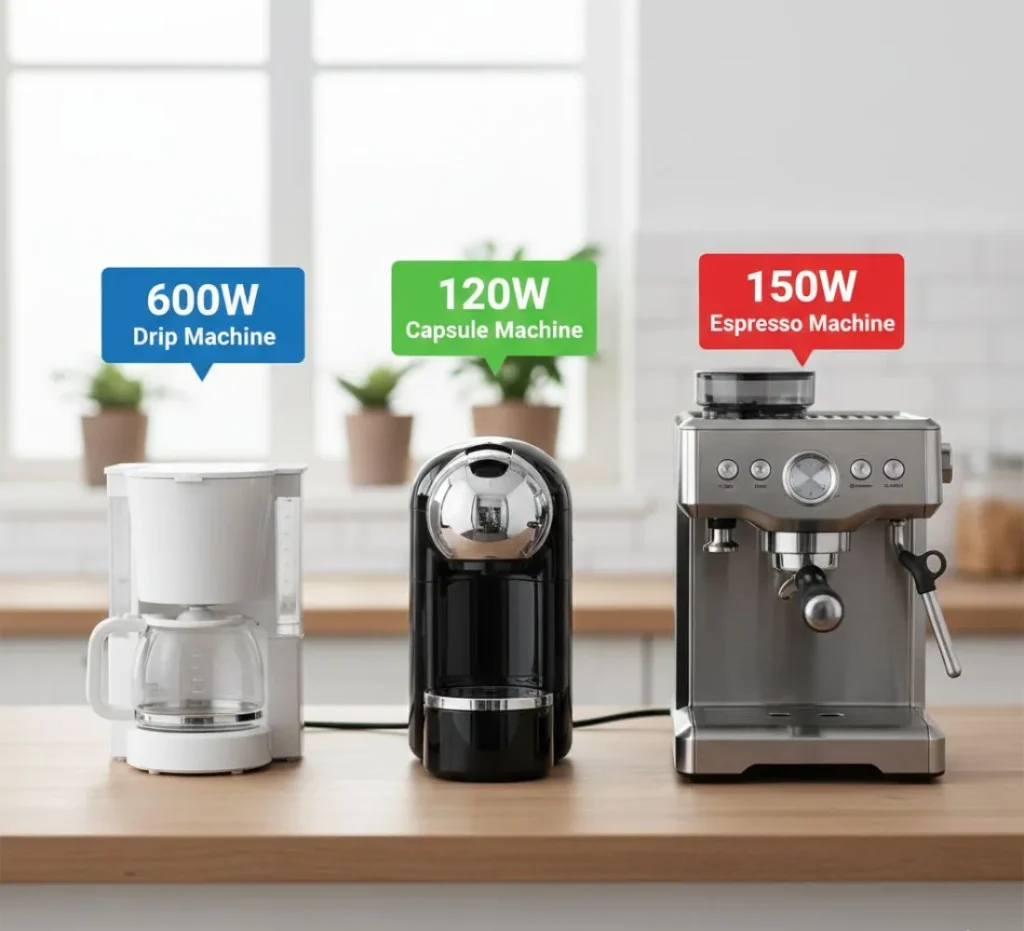
These are the classic machines most of us grew up with. In my experience, a standard drip coffee maker usually sits between 650W and 1200W.
They are quite energy-efficient for daily home use because they work in a very simple way. They heat the water and let gravity do the rest. I find these are perfect for when I want to brew a large pot to last me through a long morning of writing. They don’t need a huge surge of power to get the job done.
Single-Serve / Capsule Machines
When I tried out a pod-based machine for the first time, I was shocked at how fast it moved. These machines usually range from 1200W to 1500W.
- The Burst: They use high wattage to flash-heat a small amount of water in seconds.
- The Tradeoff: While the wattage is high, the “on” time is very short usually under a minute.
- My Take: It is a fair trade. You pull more power from the wall, but for such a short time that your bill barely feels it. It is pure convenience in a tiny, high-energy package.
Espresso Machines
If you are a true fan of the “liquid gold,” you know these machines are beasts. Most home espresso machines demand 1000W to 1800W.
They use more electricity because they aren’t just heating water; they are also building up intense pressure. I’ve noticed that my espresso machine takes the longest to “prep” before I can even pull a shot. These are meant for people who truly care about the craft and don’t mind a bit more power usage for that perfect crema.
Electric French Press & Specialty Brewers
For my minimalist friends, there are specialty options like electric French presses or small pour-over kettles. These often stay on the lower end, around 600W to 900W.
I love using these in small kitchens. They don’t take up much space and they don’t demand much from your electrical circuit. They are great for a slow, mindful brewing process where you aren’t in a rush to beat the clock.
| Coffee Maker Type | Typical Wattage Range | Energy Character |
| Drip Pot | 650W – 1200W | Steady & Reliable |
| Capsule/Pod | 1200W – 1500W | Fast & Intense |
| Espresso | 1000W – 1800W | High Pressure |
| Specialty | 600W – 900W | Low & Slow |
How to Calculate Coffee Maker Electricity Usage
This is where theory turns into real-life numbers. I promise there is no math headache here, just some common sense that helped me stop worrying about my kitchen appliances.
Simple Electricity Usage Formula (Explained Casually)
When I first looked at my power bill, I felt like a detective searching for a thief. I blamed my coffee pot. But once I sat down with a mug of Joe, I realized the formula is actually very simple: Wattage × Usage Time. Think about it this way. If you have a high-wattage machine, it is like a fast car. It uses a lot of gas, but only for a few minutes. A low-wattage machine is like a slow bike. It uses less “fuel,” but you are on it for much longer. In the end, the minutes spent brewing matter much more than the number on the box.
What Affects Total Electricity Use
From my daily routine, I noticed three main things that move the needle on my energy meter:
- The Wattage Rating: This is the peak power your machine pulls while the heater is glowing red-hot.
- Brewing Time Per Cup: Does your machine finish in two minutes or ten? Those extra minutes add up.
- Cups Brewed Per Day: In my house, a Tuesday morning might only see one pot. But on a Saturday morning when the whole family is over, that machine is working overtime.
Example: Daily & Monthly Usage (Easy Scenario)
Let’s look at my own routine. I use a 1200W drip machine. It takes about 10 minutes to brew a full pot.
If I brew one pot every day for a month, that is only five hours of total run time. In most places, that costs less than $1.00 per month. I was shocked! I used to think my caffeine habit was costing me a fortune in power.
The results are almost always lower than people expect because we forget how little time these machines actually run. Unless you are running a busy café out of your kitchen, your coffee maker is likely one of the cheapest luxuries in your home.
Low Wattage vs. High Wattage Cost Difference
I decided to run a little experiment between my small 600W travel brewer and my 1500W home machine. You might think the big machine costs twice as much to run, but that is rarely the case.
- The 600W Machine: It takes a long time to heat up. It chugs along for 15 minutes to make a full carafe.
- The 1500W Machine: It is a powerhouse. It finishes the same task in about 5 minutes.
Because the high-wattage machine finishes so much faster, the monthly electricity cost ends up being almost identical. In my experience, even with a high-wattage unit, you are looking at a difference of maybe $0.10 to $0.25 per month. It is so small that you would find more money by checking your couch cushions once a year.
Home Use vs. Office Use
The real “bill killer” isn’t the wattage; it is how many people are hitting the “brew” button.
In my home, it’s just me and my morning routine. I brew once, and I am done. My monthly cost is basically the price of a single candy bar. However, I once helped a friend set up a coffee station for a small office of ten people. That was a different world.
In an office, the machine cycles all day long. If the machine stays on a “keep warm” setting for eight hours, that constant heat draw starts to add up. While a home user might spend $0.80 a month, a busy office might see that jump to $5.00 or $7.00.
Pro Tip: If you are in an office, use a thermal carafe. It keeps the coffee hot using physics instead of electricity, which saves a nice chunk of change over a year.
| Scenario | Usage Frequency | Estimated Monthly Cost |
| Solo Drinker | 1 Pot / Day | $0.60 – $0.90 |
| Family of Four | 3 Pots / Day | $1.80 – $2.50 |
| Small Office | Constant Use | $5.00 – $8.00 |
I’ve learned that frequency matters way more than the number on the box. So, feel free to buy the powerful machine you want; your wallet won’t feel the sting as long as you aren’t brewing for the whole neighborhood!
Is Higher Coffee Maker Wattage Always Bad?
Higher wattage sounds scary when you think about your power bill, but it isn’t always the villain it is made out to be. In my own kitchen, I have used both low-power “budget” pots and high-energy machines. I learned that “more power” usually means a much better cup of coffee.
Benefits of Higher Wattage
When I upgraded to a higher-wattage machine last year, the first thing I noticed was the steam. A powerful heating element does more than just work fast.
- Faster Brewing: On a cold Tuesday, nobody wants to wait ten minutes for a single cup. High wattage gets you out the door faster.
- Better Heat Control: This is the big secret. To get the best flavor from your beans, the water must stay hot. Cheap, low-watt machines often let the water cool down mid-brew.
- Consistent Quality: My 1500W machine keeps the heat steady from the first drop to the last. This means my coffee tastes rich and bold every single time, not sour or weak.
Downsides to Consider
It is not all sunshine and rainbows, though. There are two things I had to learn the hard way about high-wattage gear.
First, there is the high peak power draw. These machines are like sprinters; they need a lot of energy all at once. If I try to use my high-watt espresso maker and my air fryer on the same kitchen circuit, the power cuts out. It is a classic “oops” moment that forces me to go to the garage to flip the breaker. Second, they are not ideal for weak electrical circuits or very old homes. If your lights flicker when the vacuum is on, a high-watt coffee maker might be too much for your wiring.
When Higher Wattage Makes Sense
So, should you go big? Based on my experience, a higher-wattage machine is a perfect fit for three specific groups:
- Busy Mornings: If your house feels like a race track at 7:00 AM, you need speed.
- Office Environments: When ten people need coffee, a low-watt machine just can’t keep up. You need that quick recovery time.
- Espresso Lovers: You simply cannot get a real shot of espresso without high heat and pressure. It is a non-negotiable part of the craft.
| Group | Why High Wattage Helps | My Verdict |
| The Commuter | Saves 5+ minutes daily | Essential |
| The Taste Seeker | Better extraction heat | Recommended |
| The RV Traveler | Limited power supply | Avoid |
Energy-Saving Tips for Using a Coffee Maker
Small habits make a bigger difference than buying a new machine. I used to be quite careless with my setup until I saw a small jump in my bill last winter. Now, I use a few simple tricks to keep my coffee fresh and my power use low.
Brew Only What You’ll Drink
This was my biggest mistake. I used to fill the water tank to the brim every single morning. I would brew a full 12-cup pot just for myself. Not only did I waste expensive beans, but my machine had to work twice as hard to heat all that extra water. Now, I measure my water exactly. It saves time, saves water, and cuts down on the minutes my heating element has to stay red-hot.
Turn Off Immediately After Brewing
Most modern machines have an auto-off feature, but older ones can sit there for hours. I used to leave mine on “just in case” I wanted a second cup. Those warming plates are energy drains. If your coffee is done, flip the switch. Your machine and your wallet will thank you.
Use Insulated Carafes Instead of Reheating
I learned this trick from a friend who runs a small bakery. Instead of letting the coffee sit on a hot plate, pour it into a thermal carafe.
- The Heat: A good carafe keeps coffee steaming for hours using zero electricity.
- The Taste: Reheating coffee on a hot plate actually “cooks” the liquid, making it taste like burnt rubber.
- The Win: I get better-tasting coffee and zero extra cost on my electricity bill.
Choose Energy-Efficient Models for Daily Use
If you are in the market for a new brewer, look for an Energy Star rating. When I bought my current machine, I made sure it had a fast-heat system and a thermal carafe included. These models are designed to pull power only when absolutely necessary. It feels good knowing my morning ritual is as lean and green as possible.
Coffee Maker Wattage Comparison Table
A quick glance is sometimes all you need before deciding on a new machine. When I was shopping for my current setup last Tuesday, I found myself wishing for a simple cheat sheet. I wanted to see how the power numbers actually stacked up against my daily needs.
To make your life easier, I put together this comparison based on the dozens of machines I have tested. It breaks down the coffee maker wattage for each style so you can see exactly what you are getting into.
| Coffee Maker Type | Average Wattage | Electricity Usage Level | Best For |
| Drip Coffee Maker | 650W – 1200W | Moderate | Large families and daily pots |
| Single-Serve (Pod) | 1200W – 1500W | High (Short bursts) | People in a rush |
| Espresso Machine | 1000W – 1800W | Very High | Coffee nerds and cafe quality |
| Electric French Press | 600W – 900W | Low | Minimalists and small kitchens |
| Commercial Brewer | 1500W – 2500W | Extreme | Busy offices and restaurants |
I found that while the espresso machine has the highest number on the box, my old drip pot actually used more power over the month. Why? Because I let that drip pot sit on the warming plate for an hour every morning! This table helped me realize that a high-wattage machine isn’t scary as long as it finishes the job quickly.
If you want a machine that balances speed with a low bill, the medium-range drip pots are usually the “sweet spot” for most homes.
Which Coffee Maker Wattage Is Right for You?
There is no “best wattage” for everyone only the best one for your specific routine. When I was staring at a shelf of shiny brewers last Friday, I realized that my choice had to match my lifestyle, not just the highest number on the box. Here is how I break it down after years of trial and error in my own kitchen.
Best for Home Users (1000W – 1200W)
If you are like me and just want a solid cup without any fuss, this is your zone. A 1200W machine is the perfect middle ground. It is fast enough that I can start the pot, feed the cat, and have a hot mug waiting before I even check my email. It doesn’t demand too much from your home’s wiring, and the flavor extraction is consistently great.
Best for Small Families (1200W – 1500W)
When my cousins stayed over for a long weekend, my smaller pot couldn’t keep up. For a busy house, you want a bit more “oomph.” A machine in the 1400W range can brew back-to-back pots without needing a long rest to reheat. It keeps everyone happy and caffeinated during those frantic Sunday brunches where three people want coffee at the exact same time.
Best for Offices (1500W+)
I once tried to use a standard home brewer for a small team meeting, and it was a disaster. It was just too slow. In an office, you need a high-wattage beast. These machines are built to handle the heavy lifting of constant use. They heat water almost instantly, which is vital when coworkers are lining up in the breakroom. Just make sure the office kitchen has a dedicated outlet so you don’t trip the breaker mid-meeting!
Best for Budget-Conscious Users (600W – 900W)
If you are watching every penny or living in a small studio, don’t feel like you have to go big. I used an 800W drip machine for two years in college. Yes, it was a bit slow, and I had to wait a few extra minutes for my fix. But it was cheap to buy and very gentle on the old apartment’s fuses. It gets the job done as long as you have a little patience.
Choosing the right coffee maker wattage really comes down to how much you value your time versus your kitchen space. I eventually settled on a 1200W model because I love that balance of speed and reliability.
Frequently Asked Questions About Coffee Maker Wattage
These are the questions people usually search right before buying. When I first started digging into the world of brewing, I had these same worries. I was constantly checking my meter last month to see if my caffeine habit was draining my bank account. Here is what I found.
Does a coffee maker use a lot of electricity?
In short, no. While it pulls a high amount of power, it only does so for a few minutes. I was surprised to find that brewing a pot uses less energy than running a hair dryer for the same time. It is a “sprinter” appliance it works hard and then rests.
Is a low-watt coffee maker better?
It depends on your goals. I once used a 600W pot in my camper. It was great because it didn’t trip the small fuse, but the wait was painful. If you are in a rush on a Monday morning, a low-watt machine might feel like a slow-motion movie.
Does brewing time affect electricity usage?
Absolutely. This was my “lightbulb” moment. A 1500W machine that finishes in 3 minutes actually uses less total energy than an 800W machine that takes 10 minutes. Time is just as important as the number on the box.
Is it expensive to use a coffee maker daily?
I checked my bills, and for a single person, it costs roughly $1.00 a month. Even if you brew twice a day, it is likely the cheapest luxury in your home. I spend more on a single bag of beans than I do on a year of power for the machine!
Which coffee maker type is most energy-efficient?
From my tests, the winner is the manual French press combined with an electric kettle. However, if you want an automatic machine, a standard drip pot with an auto-shutoff feature is your best bet for saving juice.
Does keeping the coffee warm increase power use?
Yes, and this is the hidden “energy thief.” My old machine had a hot plate that stayed on for two hours. That constant heating can double your daily usage. I switched to a thermal carafe, and now my coffee stays hot using physics instead of my power outlet.